
- Written by Ivan Dulgerov
For the fourth consecutive year, CPSBB will host the Plovdiv Science Festival with 90 Events and over 60 Scientists from Bulgaria and abroad
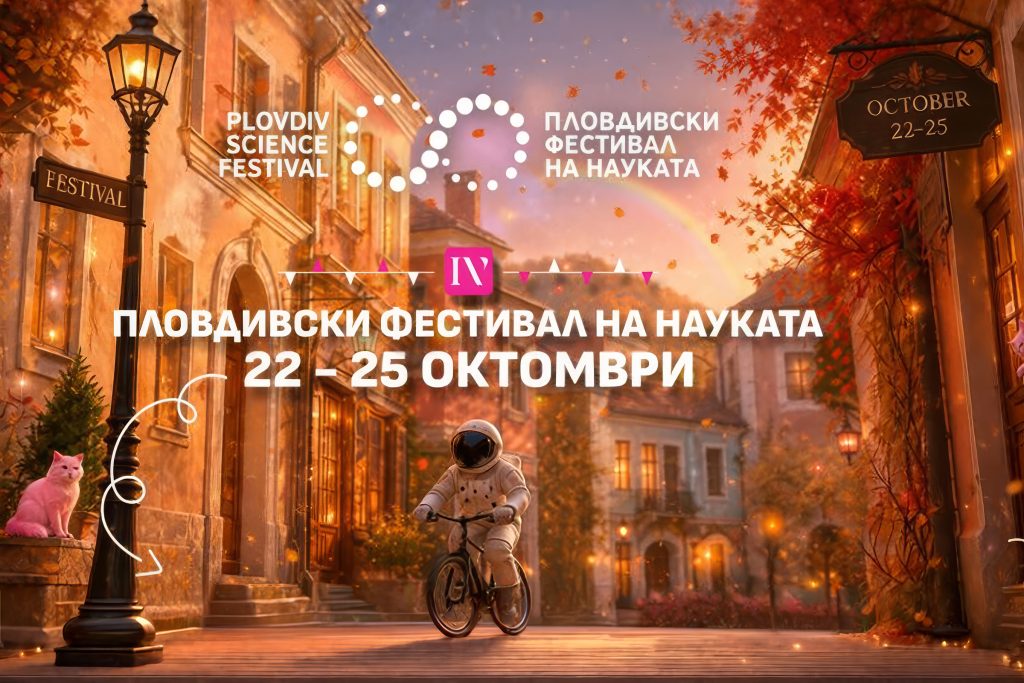
From 22 to 25 October 2026, the Center for Plant System Biology and Biotechnology (CPSBB) in Plovdiv will once again become a meeting place for science and society. The fourth edition of the Plovdiv Science Festival will feature nearly 90 events with the participation of more than 60 scientists, researchers, and experts from Bulgaria and abroad.
During the four-day event, visitors will have the opportunity to discover the world of scientific achievements through public lectures, interactive demonstrations, hands-on workshops, experiments, and exhibitions. The programme covers a broad range of topics – from climate change, sustainable agriculture, and biodiversity conservation to space research, medicine, artificial intelligence, future technologies, and the relationship between science and art.
One of the highlights of the programme is the participation of Dr. Aakansha Kanojia, a molecular biologist at CPSBB, who will give a public lecture on 22 October at 5:30 p.m. entitled “Bread for the Future: Crop Resilience in the Era of Global Environmental Challenges.”
Dr. Kanojia will present research conducted at CPSBB on the application of plant biostimulants developed from extracts of Atlantic brown seaweeds. She will explain how these natural compounds can support the growth, resilience, and productivity of crops, presenting experimental results from maize, tomato, pepper, and eggplant. Particular attention will be paid to the physiological and molecular mechanisms through which plants respond to desiccation, as well as to opportunities for developing more sustainable agricultural practices in the face of global drought.
The festival programme will also feature a wide range of numrous initiatives exploring different aspects of science. Visitors will learn how climate change affects women and men differently, how light governs life on Earth, how satellite navigation systems are developing, and how genetic research is revealing the secrets of the human body. Special attention will be paid to the potential of modern biotechnology to transform scientific discoveries into sustainable innovations.
Space, technology, and the future of humanity will also play an important role in the programme. Among the international guests is Irish researcher and science communicator Niamh Shaw, who will present the interactive science show “The Shape of Water”. She will explore how humans and animals survive in extreme environments – from the polar regions of Earth to simulated missions to Mars. Audiences will also have the opportunity to watch the documentary “The Blue Planet Through the Porthole – Shenzhou-13,” filmed aboard the Chinese space station.
Other events will focus on artificial intelligence and its applications in nutrition, the development of next-generation 6G communication technologies, the mineral resources on which future technologies depend, and the use of mathematical models to investigate natural processes.
Nature science enthusiasts will be able to explore research on the conservation of endangered animal species, the role of fossils in reconstructing Earth’s history, and modern approaches to treating infectious and chronic diseases. British palaeontologist Dr. Michael Sandy will lead young visitors on a real “fossil hunt”, while scientists from different fields will demonstrate how chemistry, physics, and biology are present even in everyday activities such as preparing food.
For the first time, the Plovdiv Science Festival programme will also include a science theatre performance. On 24 October, at the Chamber Hall of the Plovdiv Drama Theatre, the theatre company 36 Monkeys will present “The Bees” – an interactive performance dedicated to the remarkable organisation of bee societies, the importance of pollinators for ecosystems, and the challenges they face in surviving. The event forms part of the festival’s special focus on the interaction between science and art.
On 22 and 23 October, the festival will offer a specialised school programme featuring scientific demonstrations, experiments, and hands-on activities. Students will be able to experiment with chemical reactions, programme robots, explore optical phenomena, learn about genetics, and discover how science helps us understand and protect nature. Special workshops for teachers focusing on modern educational technologies are also planned.
During the weekend, the programme will be aimed at visitors of all ages, offering opportunities for shared family experiences as well as parallel activities for children and adults.
The programme will be complemented by four exhibitions, including “Invisible Antarctica: Close to the Impossible,” “Polish Inventions That Changed the World,” and “Poland in Space – The Ignis Mission,” as well as an exhibition by the Bulgarian Association of Young Polar Researchers.
The Plovdiv Science Festival was launched in 2023 and is held at the research complex of CPSBB. The festival is organised by the Beautiful Science Foundation, with the Ministry of Education and Science, the Bulgarian Academy of Sciences, and the Plovdiv 2019 Foundation as key partners, alongside the support of numerous academic, educational, and international partners.
The festival will take place from 22 to 25 October 2026 at the CPSBB Science Complex, located at 14 “St. Knyaz Boris I – Pokrustitel” Street, Trakia District, Plovdiv.
Most events are free of charge, but advance registration is recommended due to limited capacity.
Four events require paid admission, with tickets priced at €4.
Full programme and reservations: https://beautifulscience.bg/p-programa/
Posted in News & Events

